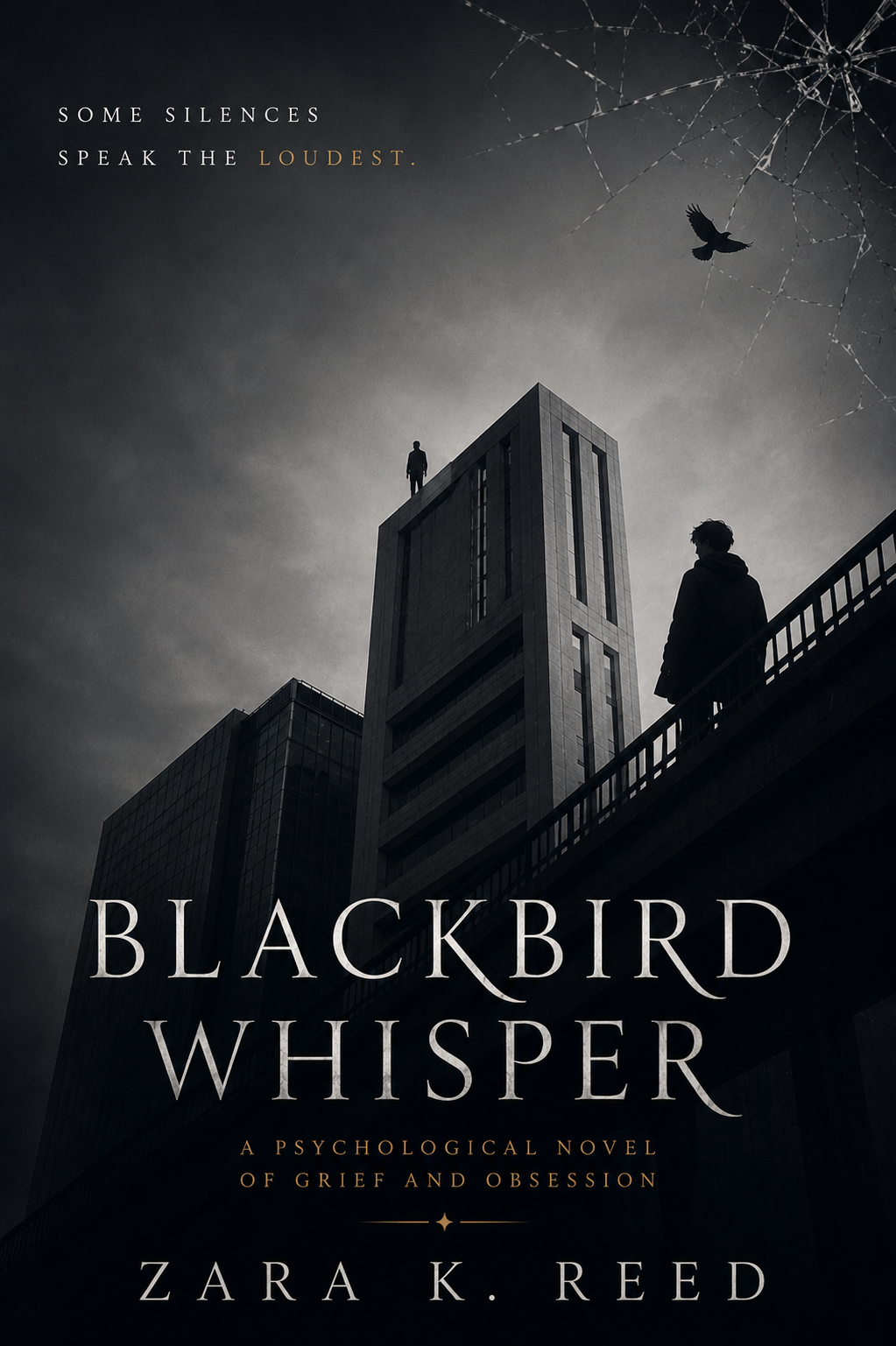
Once July 2024 arrived and the murky clouds above my creative mind had cleared up, I discovered that I had, though rather by digging and diving, made my way back to a long-habitual artistic sanctuary. The reason behind the renewal of that overflowing creative flow is something I am not certain I am capable of explaining: it seems to be a recurring scenario in an artist’s life that sometimes their GPS navigator switches off out of the blue… without any warning, thus leaving its user, its host, its bizarrely wired commander with no means of further physical transportation, though in an artist’s case, the better word here would be ‘cognitive teleportation.’
The way the writing ability had abandoned me all of a sudden, it returned in a similar fashion: no knocking on the door, no ringing the bell, just breaking into the accommodation of my mental habitation.
And to that intruder, I showcased my best hospitality. That intruder I neither cursed nor ushered out. That intruder rushed to raid my mind, and with that, I was only gleeful and grateful, never upset.
Blackbird Whisper… perhaps I should grant it the title of a pioneer, owing to the fact that from July 2024 (if not even earlier) till March 2025, I could conceive many more stories… amazingly, not in the screenplay format I had always known best, but in prose, which I learned only through Blackbird Whisper, only thanks to Blackbird Whisper, only with Blackbird Whisper.
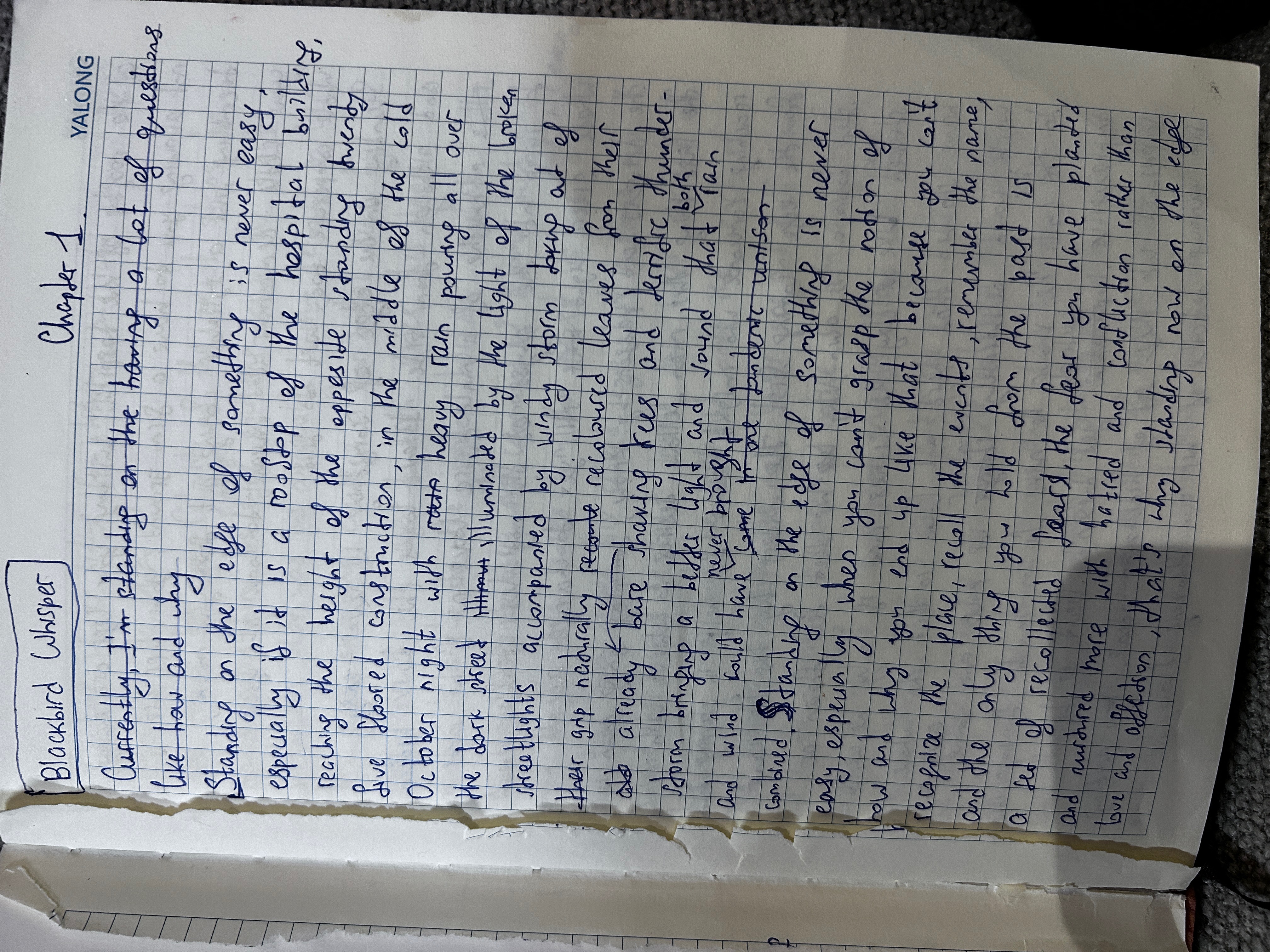
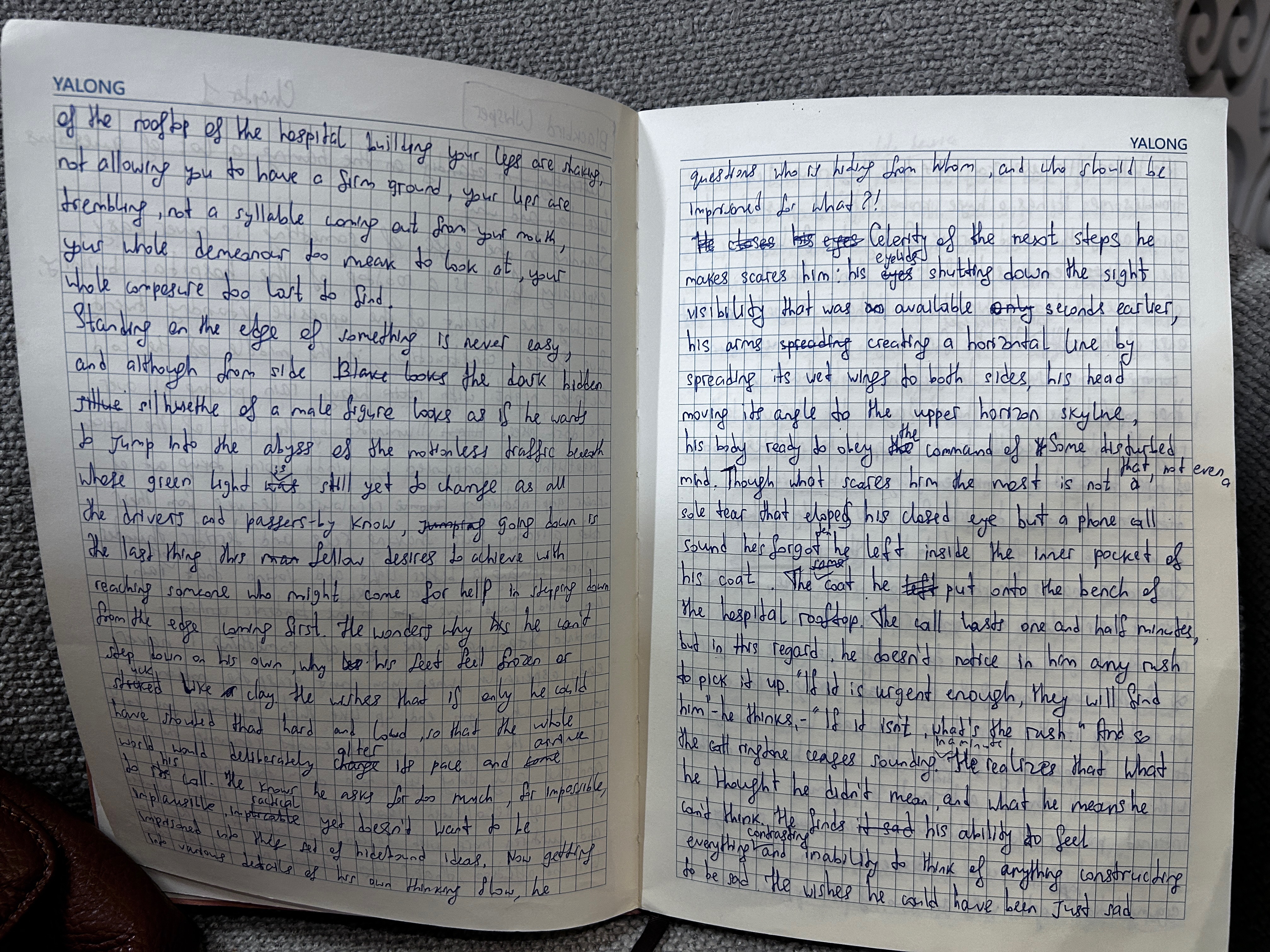
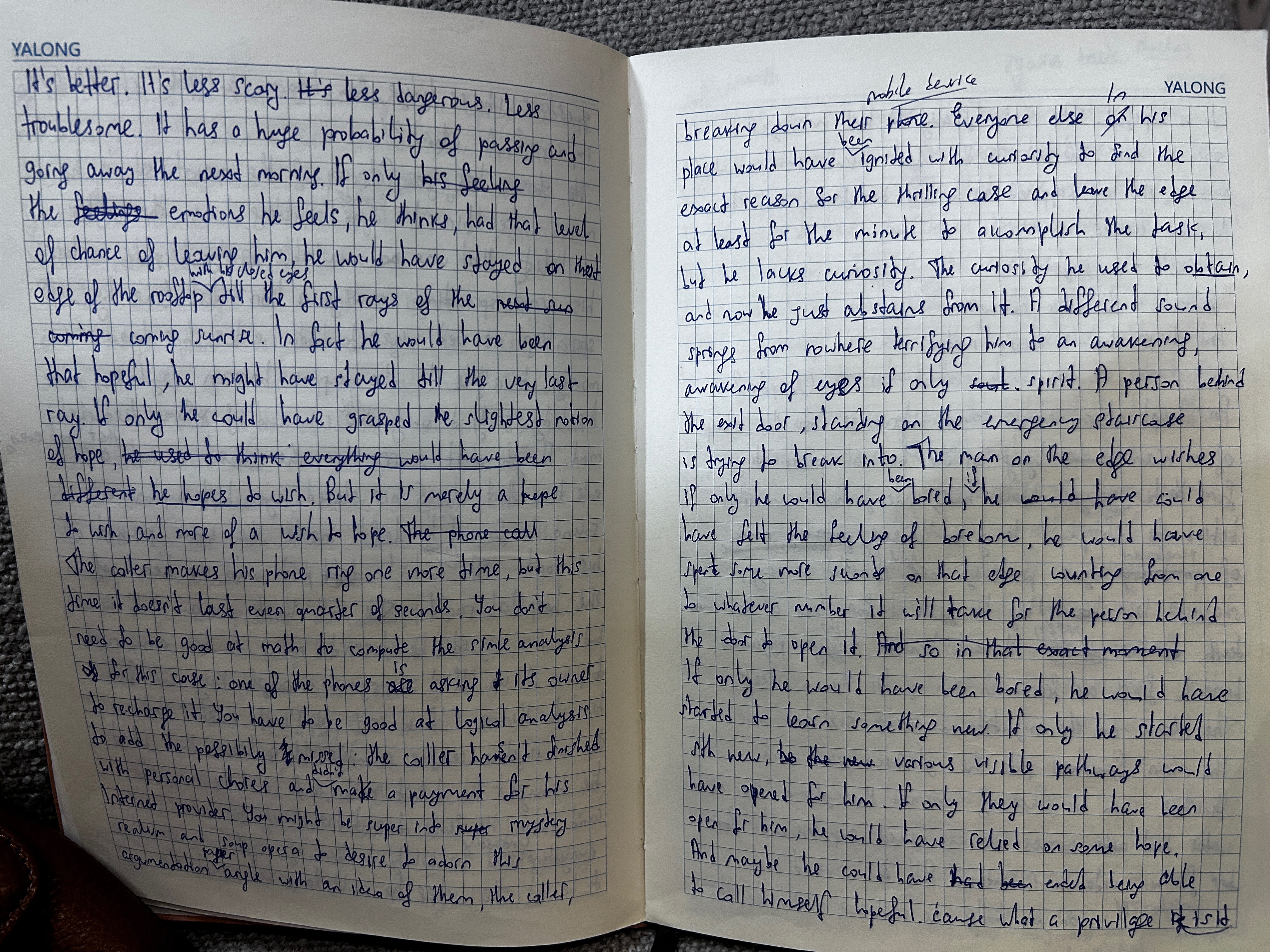
The notebook pages are part of the original writing archive.
It has just struck me that I’ve never shared even glimpses of the process of adapting the work from one medium to another.
The thing is, unlike with Double Intervention, for Blackbird Whisper I had produced many rough drafts regarding the genesis of its screenplay form. Not one. Not two. Many. Of course, by no means do I imply that all the drafts had reached their perfect state, or even their concluding pages. If anything, the number of messy screenplay drafts most surely outnumbered the number of polished ones. Yet, eventually, even the ones that appeared to promise nothing but to stand as monuments to futile days and squandered devotion proved to be of no small consequence.
For instance, the opening movement, spread across multiple pages, first materialized as follows:
FADE IN:
EXT. HOSPITAL ROOF – NIGHT
A light thunderstorm accompanies the heavy rain. An unknown man's clothes, face included, are soaked under the downpour. He stands on the edge of the roof, his body trembling. His coat is nearby, on the rooftop's bench.
He almost gets ready to fall, but the sound of an incoming phone call from his coat's pocket intervenes in his attempt. He waits for the call to stop. And it does stop in the next minute.
He attempts to fall again, but someone's running footsteps coming from the direction of the exit door distract him from his endeavor. He waits for the door to open. And it does open in the next minute.
He smiles at the invisible guest, abruptly falling afterward.
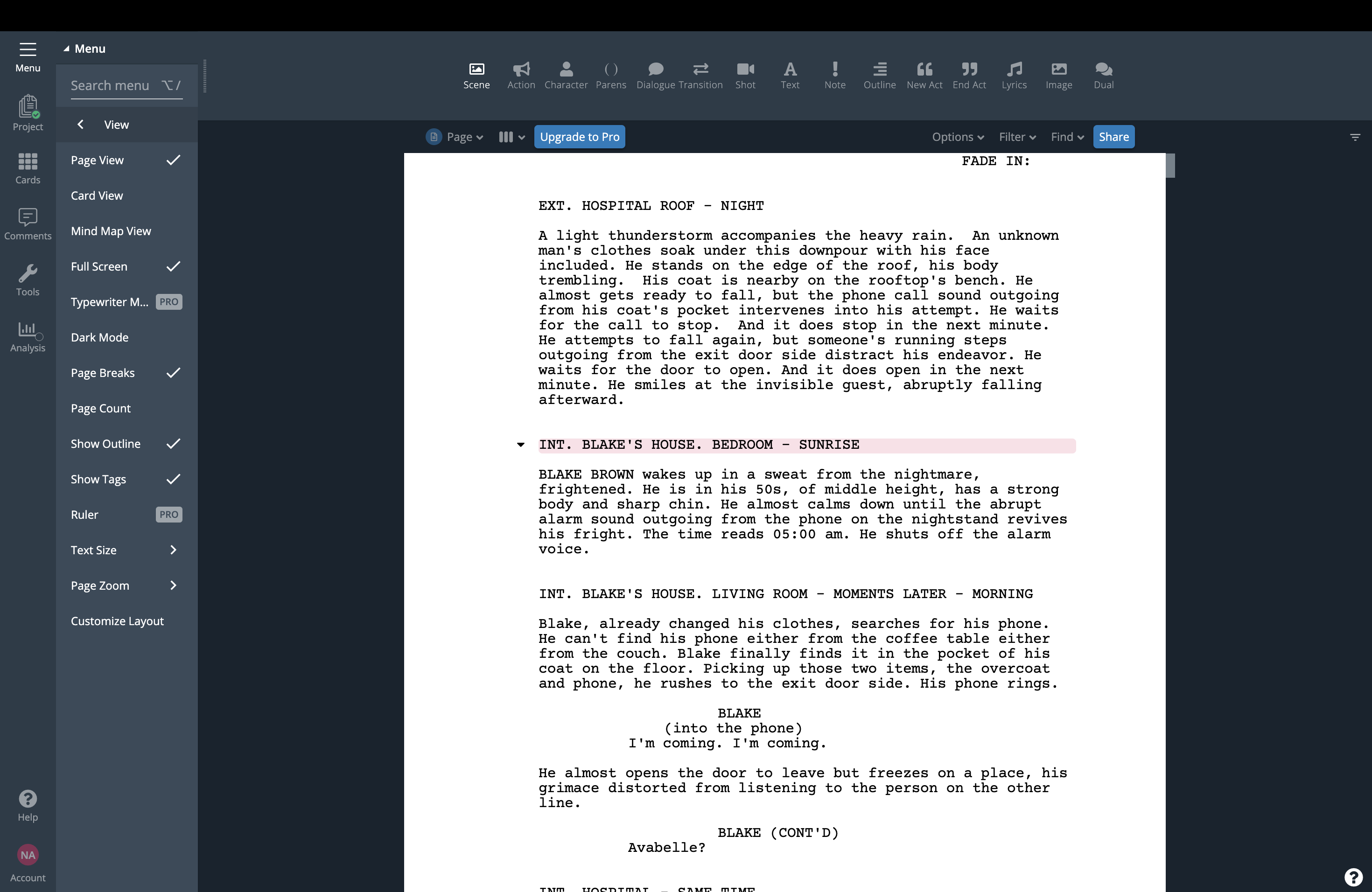
How many? How many words? In total, about 125 words or so: that is what the very first scene of my screenplay draft had comprised. I can now see it… and count, of course.
Not much. Right?
In contrast, that’s how this very scene has metamorphosed into my novel’s prologue, the first one I have ever written in my, not particularly extended, lifetime:
The first prologue
And Here
We Are
BLACKBIRD WHISPER
Standing on the edge of something is never easy, especially if it is the rooftop of a hospital building, reaching the height of the opposite, twenty-five-floored construction, in the middle of the cold October night, with heavy rain pouring all over the dark street, illuminated by the light of the broken streetlights, accompanied by a windy storm tearing naturally recoloured leaves from the grasp of their already-shaking bare trees, and a terrific thunderstorm bringing better light and sound than both rain and wind could ever have brought combined.
Standing on the edge of something is never easy, especially when they can’t grasp the notion of how and why they ended up like that, because they can’t recognize the place, recall the events, remember the name, and the only thing they hold from the past is a set of recollected fears, the fears they have planted and nurtured with more hatred and animosity than love and affection. That’s why, standing now on the edge of the rooftop of the hospital building, their legs are shaking, not allowing them to have firm ground beneath them; their lips are trembling, not a syllable coming out of their mouth; their whole demeanor is too meek to look at, their whole composure too lost to find.
Standing on the edge of something is never easy, and from the side, the dark, hidden silhouette of a male figure looks as if he wants to jump into the abyss of the motionless traffic beneath, whose green light has yet to change. As all the drivers and passers-by know, going down is the last thing this fellow desires to achieve, with reaching someone who might come to help him step down from the edge coming first. He wonders why he can’t step down on his own, why his feet feel frozen or stuck like clay. He wishes he could have shouted so hard and loud that the whole world would deliberately alter its pace and arrive at his call. He knows he asks for too much, for something impossible, implausible, impractical, yet he doesn’t want to be imprisoned in this set of hidebound ideas of restriction. Now, getting into various details of his own thinking flow, he questions who is hiding from whom, and who should be imprisoned for what?
The celerity of the next steps he takes scares him: his eyelids shutting out the sight that was available seconds earlier, his arms creating a horizontal line by spreading their wet wings to both sides, his head moving towards the upper horizontal skyline, his body ready to obey the command of some disturbed mind. Though what scares him the most is not that, not even a sole tear eloping from his closed eye, but the sound of a phone call he has forgotten he left inside the inner pocket of his coat, the coat he put onto the bench of the hospital rooftop. The call lasts one and a half minutes, but in this regard, he doesn’t notice any rush in himself to pick it up. If it is urgent enough, they will find him, he thinks.
“If it isn’t, what’s the rush?”
And so the ringtone ceases sounding. In a minute, he realizes that what he thought he didn’t mean, and what he means, he can’t think. He finds his ability to feel everything, contrasting with his inability to think of anything constructive, to be sad. He wishes he could have been just sad. It’s better: less scary, less dangerous, less troublesome. It has a huge probability of passing and going away the next morning. If only the emotions he feels, he thinks, had that level of chance of leaving him, he would have stayed on the edge of the rooftop with his eyes closed till the first rays of the coming sunrise. In fact, he would have been that hopeful; he might have stayed till the very last ray. If only he could have grasped the slightest notion of hope, everything would have been different, he hopes to wish. But it is merely a hope to wish, and more of a wish to hope. The caller makes his phone ring one more time, but this time it doesn’t last even a quarter of a second. One does not need to be good at math to compute the simple analysis for this case: one of the phones is asking its owner to recharge it. One has to be good at logical analysis to add the possibility missed: the caller hasn’t finished personal chores and hasn’t made a payment to their Internet provider. One might be super into mystery realism and soap opera to desire to adorn this argumentation-paper angle with the idea of them, the caller, breaking down their mobile device. Everyone else in his place would have been ignited with curiosity to find the exact reason for the thrilling case and leave the edge at least for a minute to accomplish the task, but he lacks curiosity. The curiosity he used to possess, but now he just abstains from it. A different sound springs from nowhere, terrifying him into an awakening, an awakening of the eyes, if only of the spirit. A person behind the exit door, standing on the emergency staircase, is trying to break in. The man on the edge wishes he could have been bored; if he could have felt the feeling of boredom, he would have spent some more seconds on that edge, counting from one to whatever number it would take for the person behind the door to open it. If only he had been bored, he would have started to learn something new. If only he had started something new, various visible pathways could have opened for him. If only they could have been open for him, he could have relied on some hope. And maybe he could have ended up being able to call himself hopeful, ’cause what a privilege it is to be hopeful. The savior at last manages to open the door. The man on the edge doesn’t know at what number this had happened, as he was too frozen and stuck to count earlier.
“Why are you here?” one asks.
“I have the same question for you!” the other feels no hesitation in replying.
And why they ended up there is a mystery that needs to be unfolded.
How many in total? How many words did it take to stretch a 125-word screenplay opening scene? It seems to me, if Google Drive’s counting ability doesn’t lie, that the prologue has grown to approximately 1,000 words.
That is like eight times more than the original intent, the original intent being none other than a screenplay draft.
If you gave me any other screenplay scene, be it an opening or a closing one, and made a genuine request to turn that piece into an elaborate and evocative part of a novel, I am not sure I could achieve it… pull it off now. In all honesty, I am plagued by a persistent ambivalence: I would fail at the given task. Given that confession, it is valid to wonder how, then, I managed to restructure the story of ‘Blackbird Whisper’ in a way that it now breathes freely in a different medium. To that I have no definite answer. To that, I can only accompany you in your wonder.
Miracle.
God sees I love this word.
Perhaps, I ought to treat my own discipline and devotion, commitment and consistency with a more generous tribute, and permit myself to bask in the merit of my making, yet…
Yet I can’t help but play with the idea of things being no less than a grand miracle.
Nonetheless, if miracles were indeed true, then shouldn’t I have by now landed an agent, a deal, something akin to a mild artistic breakthrough?
It would have been nice… won’t lie. It might be a freeing feeling to know that whatever efforts one puts into something wholeheartedly, devotedly, passionately and willingly end up proving worthwhile… debunking the possibility of endeavours and aspirations going to waste.
From a screenplay scene to a prologue. From 125 words to approximately a thousand. And from uncertainty to the possibility of a miracle.
END OF PART XII
The conversation continues.
Leave a thought, a question, or a response to the piece.